10 Best AI Tools for Students in 2026 | Tips & Guide
AI tools for students are everywhere right now. There are apps to help you find sources, proofread essays, make presentations, and even generate practice tests.
With so many options competing for attention, the real challenge isn’t finding AI study tools. It’s figuring out which ones will actually save you time and support your learning.
The best AI tools for students tend to fall into a few key categories, from text summarizers and practice quiz generators to writing and presentation tools. This guide covers the types of AI tools that will streamline your academic routine and help you study smarter, not harder.
Table of contents
- How to choose the best AI tools for students
- AI text summarizers for students
- Text-to-speech tools for studying
- AI study guide generators
- AI practice test generators
- AI academic research tools
- Citation generators
- Paraphrasing tools
- Thesis statement generators
- Grammar checkers for proofreading
- AI presentation makers
- Frequently asked questions about best AI tools for students
How to choose the best AI tools for students
Not every AI tool will improve your study routine. The best AI tools for students tend to share a few key qualities that make them genuinely helpful for academic work:
- Support active recall: Look for AI tools that help you test your knowledge and practice remembering the information that will be on a test.
- Save time on repetitive tasks: Some of the best AI study tools handle repetitive tasks, like MLA citations, so that you can focus on honing your writing voice and understanding the material.
- Support multiple academic tasks: Instead of juggling a different app for each task, look for platforms that combine multiple AI tools in one place.
- Minimize costs: Monthly subscription costs to AI study tools can add up. Look for tools that you can try or use for free or platforms that offer one affordable subscription price for multiple AI study tools.
The sections below highlight the most useful types of AI tools students rely on and how they can improve your academic workflow.
AI text summarizers for students
Reading assignments can pile up quickly, especially when you’re balancing several classes at once. While it’s important to read everything that’s assigned, text summarizers save you time and enhance your success in two ways:
- Previewing a summary of the main points before reading accelerates your comprehension when you’re actually reading the article or chapter from start to finish.
- When you’re studying for an exam, summaries of the reading assignments help you review the most important concepts.
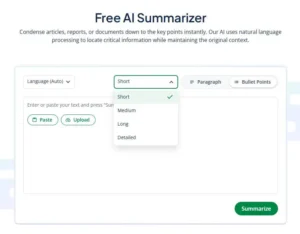
With QuillBot’s free Summarizer, you can choose from two convenient formats: a paragraph or a bulleted list of main points. You can also choose from four different summary lengths: short, medium, long, or detailed.
QuillBot’s AI Summarizer
Text-to-speech tools for studying
Students absorb information in different ways. While some people prefer reading text, others learn more effectively by listening.
Text-to-speech (TTS) tools convert written content into audio, allowing you to hear passages read aloud. This can make dense readings more accessible and give you another pathway for understanding complex material. These tools can also be useful when you want to review notes while commuting or exercising.
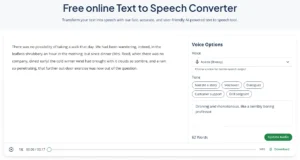
QuillBot’s Text to Speech Converter includes over a dozen voices and several different tones to choose from. You can also adjust the playback speed, which is useful for reading and listening at once.
QuillBot’sText to Speech Converter
AI study guide generators
Preparing for exams often involves turning scattered notes into an organized study guide, but this process can be quite time-consuming.
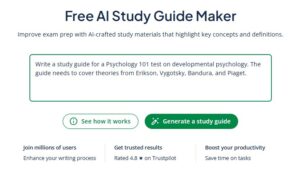
An AI study guide generator turns your AI prompt into a structured summary that highlights the key concepts, definitions, and themes for a specific academic topic, such as poetic devices or cellular respiration. You don’t have to agonize over which format or headings to use or which details to include in the initial draft.
QuillBot’s Study Guide Maker is completely free to try, and it’s available on a platform with many other AI study tools.
AI prompt for QuillBot’s Study Guide Maker
AI practice test generators
The best study methods involve active recall, also known as memory retrieval practice. When you practice remembering facts without looking at your book or notes, you’re more likely to remember them on the day of the test. A practice test is one of the simplest forms of active recall. That’s why AI test generators should be part of every student’s toolkit.
To use an AI test or quiz generator, upload or copy/paste the study materials that the test should cover, and specify the number and types of questions you need to practice. You can also prompt the AI with an answer key before or after you take the practice test.
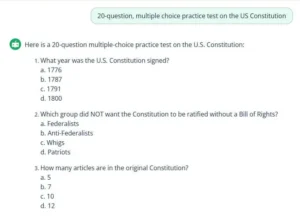
QuillBot’s free Test Generator makes practice tests based on any study materials or instructions you provide.
Practice test generated by QuillBot’s Test Generator
AI academic research tools
Starting a research paper can be intimidating, especially when the academic database you’re using has hundreds or even thousands of results on your topic. While databases are essential for finding scholarly sources, they can be difficult to navigate when you’re still trying to understand a topic or figure out what to search for.
Academic research tools make the early stages of research easier by helping you explore a topic and identify potential sources. Instead of guessing which keywords to try in a database, you can ask an AI tool to suggest relevant search phrases, important subtopics, or examples of academic sources related to your assignment.
With QuillBot’s AI Search, you can quickly and easily generate a list of scholarly sources or keywords about a topic you’re researching.
Prompt and output for scholarly sources from QuillBot’s AI Search
Citation generators
Academic writing usually involves citing sources, but formatting the bibliography correctly or citing different types of sources can be confusing. Plus, you might even be taking courses that require different styles (e.g., MLA for an English class and APA for Psychology 101).
Citation generators simplify this process by automatically formatting references according to the required style. They save you the time of looking up how to reference a journal article versus a book or film so that you can focus on developing your ideas.
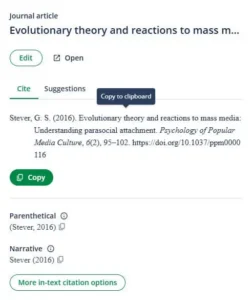
QuillBot’s Citation Generator covers every citation style you can imagine and even lets you search by each source’s title, URL, or DOI. From there, it generates a bibliographic entry and in-text citations.
APA citation and reference entry from QuillBot’s Citation Generator
Paraphrasing tools
Strong academic writing often relies on paraphrasing outside sources rather than relying heavily on direct quotations.
Paraphrasing tools help you rewrite sentences while preserving the original meaning. This can make your writing clearer and help integrate research more smoothly into an essay. You can also use paraphrasing tools to refine the tone of emails or discussion posts.
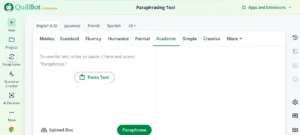
With QuillBot’s Paraphraser, you can choose from different modes, such as Formal and Academic. Plus, it includes a “Synonyms” slider that lets you choose how much you want to change the original text.
QuillBot’s free Paraphraser
Thesis statement generators
Many essays hinge on a single sentence: the thesis statement. A clear thesis sets the tone and guides the body paragraphs. But finding the right wording for a thesis can be challenging, especially when you’re still refining your ideas or when your ideas are complex.
Thesis statement generators help you turn a broad topic into a focused sentence that clearly states your main idea and guides the structure of your essay. They can also jumpstart the brainstorming process and help you get unstuck when you’re dealing with writer’s block.
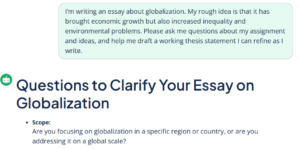
QuillBot’s Thesis Statement Generator is one of the best AI tools for students because it can ask you questions to help you clarify your main idea (like a writing tutor would) and show you different versions of a thesis statement to choose from.
Prompt and output from QuillBot’s Thesis Statement Generator
Grammar checkers for proofreading
Even essays with a clear main idea and strong supporting details can lose points because of grammar, punctuation, or clarity issues.
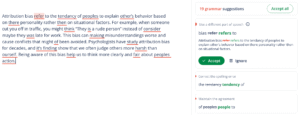
Grammar checkers are essential AI tools for students because they identify mistakes that would otherwise get overlooked. These tools scan writing for errors in grammar and punctuation, making it easier to polish a final draft.
QuillBot’s Grammar Checker is a fast and free way to proofread your essays. It consistently suggests accurate corrections and shows you how to avoid the same types of errors in future assignments.
AI presentation makers
Presentations are a common part of academic life, but creating well-structured and eye-catching slides takes time, especially if you’re still learning presentation skills.
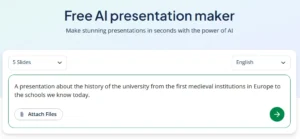
An AI presentation maker generates professional-quality slides with well-organized talking points that will boost your confidence and engage your audience. You can use them to create presentations from scratch or transform essays into PowerPoint slides.
QuillBot’s Presentation Maker includes a variety of high-quality designs and lets you upload documents with the ideas you need to present.
Frequently asked questions about best AI tools for students
- How do you use generative AI for brainstorming and prewriting?
-
To use generative AI for brainstorming and prewriting, choose a generative AI tool (e.g., QuillBot’s AI Chat), and type a prompt.
In your prompt, provide a brief description of the writing assignment and topic, and ask the tool to generate ideas for body paragraph topics. Place the description of your writing assignment in curly brackets.
Generative AI for brainstorming prompt example I’m an English Composition student who is brainstorming body paragraph topics for the following assignment: {In an 800-1000 word essay, defend an argument for or against smartphone bans in U.S. public schools}. I would like you to generate a list of the pros and cons of smartphone bans. The list should cover benefits and drawbacks for students, schools, and educators.After the generative AI tool responds to your prompt, review the list of body paragraph topics, and select the ones that you’d like to research further.
Use keywords from each item on the list as search phrases in an academic database or a search engine (e.g., smartphones and student distractions).
Then, research multiple ideas from the generative AI response in order to choose a main idea (e.g., your main argument) and body paragraph topics that are based on critical thinking.
When you’re in drafting stages of your writing task, QuillBot’s free Grammar Checker can help you avoid errors. QuillBot’s free Citation Generator can also help you create flawless citations for your outside sources.
QuillBot’s AI Detector Android App and AI Detector iOS App can help you ensure that the writing you submit for class assignments is based on your own writing voice and ideas.
- What types of research is AI search good for?
-
AI search is ideal for academic research, market analysis, literature review, policy studies, technical document analysis, and more. Whether you’re a student writing an essay or a professional researching your industry, AI search helps you understand complex materials quickly and accurately.
QuillBot’s free AI search can streamline the process for any type of research you need to do.
- Is it safe to use ChatGPT for essays?
-
Before using ChatGPT to write essays, it’s best to ask your instructor and/or check your school’s policy. If you’re allowed to use it, you’ll still need to fact-check and edit any content generated by ChatGPT to improve the writing and ensure accuracy and correct source citation.
Generative AI tools can effectively be used in combination with QuillBot’s AI Detector or AI Humanizer, which can help to humanize AI texts.
It is also important to run a plagiarism checker to confirm AI-assisted content is original and that all sources are cited correctly before submission.
Cite this QuillBot article
We encourage the use of reliable sources in all types of writing. You can copy and paste the citation or click the "Cite this article" button to automatically add it to our free Citation Generator.
QuillBot. (2026, March 16). 10 Best AI Tools for Students in 2026 | Tips & Guide. Quillbot. Retrieved March 20, 2026, from /blog/education/ai-tools-for-students/