Published on
January 27, 2025
by
Nicole Routh, M.Ed.
Revised on
November 27, 2025
A cardinal number is a whole number (e.g., “three”) rather than a fraction (e.g., “one third”) or an ordinal number (e.g., “third”). In writing, cardinal numbers are determiners that show the quantities of nouns (e.g., “three cups of coffee”).
Cardinal numbers can go right before the nouns they modify or before other modifiers (e.g., adverbs and adjectives). When a noun has multiple determiners—such as the definite article “the” or the possessive adjective “my”—they always go before a cardinal number.
Depending on the style guidelines you’re using, you can write cardinal numbers as words (e.g., “seven”) or numerals (e.g., “11”). Some style guides recommend words for the cardinal numbers one through nine and numerals for 10 and greater.
Cardinal number examplesThe university awarded full scholarships to 15students.
Mythreeblackcats all have different personalities.
The manager hired fourhighlyqualified software engineers.
Published on
January 18, 2025
by
Nicole Routh, M.Ed.
Revised on
November 27, 2025
The definite article “the” is a determiner that goes before a specific rather than a general version of a noun. The noun can be singular (e.g., “the house”) or plural (e.g., “the cars”). Definite articles can also modify countable nouns (e.g., “the song”) or uncountable nouns (e.g., “the music”).
The rules about when to use definite articles depend on two factors.
Singular, countable nouns always need a determiner:
The definite article “the” or another determiner (e.g., “Paul’s” or “that”) for a specific version (e.g., “I enjoyed the first song on Ringo’s new album”)
An indefinite article—“a” or “an”—for a general version (e.g., “I hope he releases a new album again soon”)
For plural nouns and uncountable nouns (nouns without a plural form), you have these options:
The definite article “the” or another determiner for specific versions (e.g., “The salt I bought today is from Portugal”)
Zero determiner for general versions (e.g., “I’m craving salt” or “Pretzels make me thirsty”)
In a sentence, “the” is located before the noun it modifies (if there are no other modifiers), the noun’s first adjective, or an adverb that modifies the noun’s first adjective.
Definite article examplesJames is the title of Percival Everett’s latest novel.
Louise served thehot artichoke dip on New Year’s Eve.
Theextremelyrare spider that the scientists discovered is harmless.
To use “the” correctly, follow the definite article guidelines below, or use QuillBot’s free Grammar Checker.
Published on
January 16, 2025
by
Nicole Routh, M.Ed.
Revised on
November 27, 2025
An indefinite article is a type of determiner that goes before a singular, countable noun. The two indefinite articles in English are “a” and “an.” Indefinite articles are for general or unspecified versions of nouns, and the definite article (or another determiner) is for specific versions (e.g., “a book” rather than “the book that I read last week”).
You can use an indefinite article before one of these words:
The noun it modifies (if there are no other modifiers)
The adverb that modifies the noun’s first adjective
When a noun has multiple modifiers, the article or other determiner is always the first modifier.
The choice between “a” or “an” depends on the pronunciation of the next word. Use “a” when the next word begins with a vowel sound and “an” when the next word begins with a consonant sound.
Indefinite article examplesThe neighbor needs to borrow anegg for arecipe.
Jeff wrote abeautifulsong about amountain.
Fatima had anespeciallyproductivemorning at work today.
Published on
January 15, 2025
by
Nicole Routh, M.Ed.
Revised on
January 21, 2026
AMA in-text citations are superscript numbers in the main text that direct readers to numbered entries on an AMA reference page.
Each AMA reference entry begins with a number and includes the author, title, and other publication details. Number these entries in the order that you initially cite each source in the main text.
Each source has only one entry, so if you cite the same scholarly source in multiple places, use the same number for all of that source’s in-text citations.
AMA in-text citation and reference entry example
AMA in-text citation
AMA reference entry
Another recent study explored the common barriers to asthma treatment.5
5. Papi A, Blasi F, Canonica GW, et al. Treatment strategies for asthma: reshaping the concept of asthma management. Allergy, Asthma & Clinical Immunology. 2020;16:1-11. doi:10.1186/s13223-020-00472-8
To cite sources correctly in AMA style, follow the examples and guidelines below, or use QuillBot’s free Citation Generator. To double-check that all sources are correctly cited, you can also run a plagiarism checker before submitting your work.
Published on
January 13, 2025
by
Nicole Routh, M.Ed.
Revised on
October 29, 2025
Endnotes are numbered citations or notes on a separate page at the end of a piece of academic writing. Each endnote begins with a number that corresponds to a superscript number in the main text (often referred to as a callout number).
Each citation style has specific guidelines about when and how to use endnotes. For example, APA and MLA endnotes are for sharing supplemental information, but in Chicago style writing, endnotes are for citations as well as supplemental details.
Chicago style endnotes example
TipWith the QuillBot Citation Generator, you can instantly create accurate Chicago style endnote citations. QuillBot’s Grammar Checker can also help you ensure that APA and MLA endnotes are error free.
Published on
January 9, 2025
by
Nicole Routh, M.Ed.
Revised on
October 29, 2025
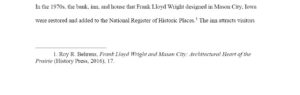
Footnotes are numbered citations or notes at the bottom of a page in a piece of academic writing. Each footnote begins with a number that corresponds to a superscript number in the main text.
The citation style you’re using determines when and how to use footnotes. For example, APA footnotes and MLA footnotes are for sharing extra information, but in Chicago style, footnotes are for citing sources.
Chicago style footnotes example
NoteFootnotes are similar to endnotes, and they usually serve the same purpose (e.g., they’re both options for Chicago style citations). Whereas footnotes go in the footer of each page that has the superscript callout, endnotes go on a separate page at the end of the document.TipWith the QuillBot Citation Generator, you can instantly create accurate Chicago citations. QuillBot’s Grammar Checker can also help you ensure that APA and MLA footnotes are error free.
Each APA footnote begins with a superscript number that corresponds to a superscript callout number in the main text—like this.¹ You can place each footnote in the footer of the page with the callout number or on a separate footnotes page after the APA reference page.
APA footnote example
¹ Other general practitioner screening tools for Alzheimer’s include the Mini-Mental State Examination (Folstein et al., 1975) and the General Practitioner Assessment of Cognition (Brodaty et al., 2002).
Published on
December 30, 2024
by
Nicole Routh, M.Ed.
Revised on
January 21, 2026
If you’re writing an essay in Chicago style, there’s a good chance that some of your scholarly sources will be journal articles. Chicago has two citation systems—notes and bibliography and author-date (which is far less common).
In essays using the notes and bibliography system, each journal article that you quote, summarize, or paraphrase needs two forms of citation:
An entry on a bibliography at the end of the document
A numbered footnote for each sentence that has information from the article
Use the examples below to learn about Chicago format for journal articles, or try QuillBot’s free Citation Generator to create in-text citations and Works Cited entries. Additionally, QuillBot’s online Notepad can help you take notes online and keep track of relevant source information.
TipTo ensure that all sources are correctly cited, it is also a good idea to run a plagiarism checker before submitting your work.
How to cite a journal article Chicago examples
Footnotes
Bibliography
3. Guangbin Shi, “From Trap to Memphis Rap: The Incorporation and Reconfiguration of American Southern Hip-Hop Music in China,” Journal of Popular Music Studies 36, no. 4 (2024): 121, https://doi.org/10.1525/jpms.2024.36.4.112.
Shi, Guangbin. “From Trap to Memphis Rap: The Incorporation and Reconfiguration of American Southern Hip-Hop Music in China.” Journal of Popular Music Studies 36, no. 4 (2024): 112–40. https://doi.org/10.1525/jpms.2024.36.4.112.
Published on
December 19, 2024
by
Nicole Routh, M.Ed.
Revised on
January 21, 2026
When you’re writing Chicago style essays for history courses and other disciplines, you may end up using scholarly sources from websites.
Chicago style offers two different citation systems—notes and bibliography (the most common and therefore the main focus of this article) and author-date.
In the notes and bibliography system, Chicago requires two types of citations for websites (and all other types of sources):
A numbered footnote for each sentence that quotes or paraphrases the website
An entry on the Bibliography page at the end of your document
The format for the footnotes and bibliography entry depends on several factors, such as the type of author. Chicago website citations don’t need page numbers unless the source has numbered pages (e.g., a PDF).
The examples and tips below cover a few variations of Chicago website citations. QuillBot’s free Citation Generator can also help you cite websites in Chicago style. Additionally, our Notepad lets you take online notes to keep track of relevant source material.
TipTo ensure that all sources are properly credited and no uncited material remains, it is a good idea to run an online plagiarism checker before submitting your work.
Chicago website citations examples
Full note
Bibliography
3. Manohla Dargis, “‘Wicked’ Review: We’re Off To See the Witches,” New York Times, November 27, 2024, https://www.nytimes.com/2024/11/21/movies/wicked-review.html.
Dargis, Manohla. “‘Wicked’ Review: We’re Off To See the Witches.” New York Times. November 27, 2024. https://www.nytimes.com/2024/11/21/movies/wicked-review.html.
Published on
December 13, 2024
by
Nicole Routh, M.Ed.
Revised on
December 30, 2025
Quotes about success inspire people to persevere and achieve goals. They can be especially effective in business presentations, email signatures, and team memos. Success quotes can even work well in some types of essays.
Reading success quotes from time to time can boost productivity and reignite motivation.
Whether you’re seeking quotes for work, school, or your own personal development, these 20 examples provide helpful insights about how to succeed. For even more quote options, try out QuillBot’s free AI random quote generator.